Texas Fire Alarm System Requirements
Staying compliant with Texas fire alarm codes is not optional. Whether you manage a school, an office building, a retail center, or a multifamily property, state and local fire codes determine when a fire alarm system is required, what it has to include, and how often it has to be tested.
This guide from FireTron walks through Texas fire alarm requirements for commercial and residential buildings, what NFPA 72 actually requires at each coverage level, and how compliance is enforced by the Texas State Fire Marshal’s Office and local jurisdictions like Houston, Austin, and Katy.
Summary:
- Most commercial buildings over a certain occupancy or size need a fire alarm system under Texas fire code and NFPA 72.
- Schools, hospitals, and other high-occupancy buildings typically require the highest coverage level, known as L1.
- Fire alarm systems must be inspected at least annually by a licensed technician, and more often in high-risk facilities.
- Cities like Houston, Austin, and Katy can layer on their own permitting and inspection requirements beyond state rules.
- Non-compliance risks include fines, business license issues, and liability exposure if a fire occurs.
- Residential fire alarm requirements differ from commercial and depend heavily on building type and occupancy.
What Does a Commercial Fire Alarm System Include?
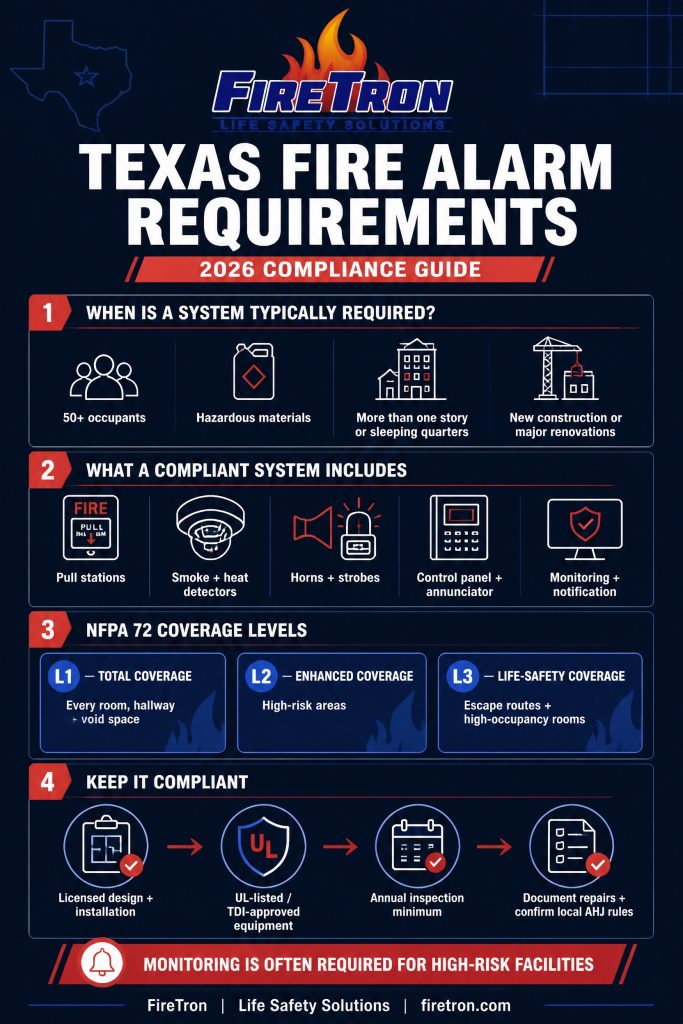
A modern fire alarm system is more than smoke detectors and sirens. At a minimum, it includes:
- Manual pull stations
- Smoke and heat detectors
- Audible and visual alarms (horns, strobes)
- Control panels and annunciators
- Monitoring and notification systems
In larger commercial buildings and schools, fire alarm systems are often integrated with fire sprinkler systems, HVAC controls, and emergency communication platforms, though each of those systems has its own separate code requirements.
When Is a Fire Alarm System Required in Texas?
Commercial Buildings
According to the Texas Department of Insurance (TDI) and the National Fire Protection Association (NFPA), a fire alarm system is required in most commercial buildings and educational facilities when:
- The building occupancy exceeds a certain threshold, typically 50 or more occupants
- Hazardous materials are stored on-site
- The building is more than one story or contains sleeping quarters, such as hotels and hospitals
- The property is undergoing new construction or renovations that exceed a specified scope
Compliance is essential not just for safety, but also for avoiding fines or forced business interruptions while violations get corrected.
Residential Buildings
Residential fire alarm requirements in Texas are different from commercial requirements, and the distinction trips up a lot of property owners.
- Single-family homes generally follow the residential building code, which requires interconnected smoke alarms in each bedroom, outside sleeping areas, and on every level, but not a full commercial-style fire alarm system
- Multifamily properties, such as apartment complexes and condominiums, are usually treated as commercial occupancies once they reach a certain size or number of stories, which triggers full fire alarm and, in many cases, sprinkler requirements
- High-rise residential buildings almost always require a monitored fire alarm system regardless of unit count, due to the difficulty of evacuation
If you manage a multifamily property and are not sure which category it falls into, that determination is made by your local Authority Having Jurisdiction (AHJ), not by a general rule of thumb.
Fire Alarm Compliance in Texas
Fire alarm compliance in Texas means meeting three separate sets of requirements at once: the national NFPA 72 code, Texas State Fire Marshal’s Office (SFMO) administrative rules, and whatever additional permitting your city requires.
At a minimum, a compliant system needs to meet the following:
- Design and installation by a licensed fire alarm contractor
- Equipment that is UL-listed and TDI-approved
- An inspection and testing schedule that meets or exceeds NFPA 72 minimums
- Documentation of every inspection, repair, and system change, kept on file for the AHJ to review
Compliance is not a one-time event. A system that passed inspection last year can fall out of compliance through battery drift, unauthorized modifications, or a change in building occupancy, which is why annual inspection is a floor, not a ceiling, for higher-risk properties.
Commercial Smoke Alarm Requirements
Smoke alarm placement is one of the most commonly misunderstood parts of commercial fire code. A building can have a fully functional fire alarm panel and still fail inspection over smoke detector coverage.
- Smoke detectors are generally required in corridors, mechanical rooms, and any space without direct occupant supervision
- High-occupancy areas, such as assembly spaces and open office floors, often require detectors spaced to a maximum coverage area per device, not just “somewhere in the room”
- Detectors must be interconnected with the building’s central fire alarm control panel, not standalone battery units, in most commercial occupancies
- Detector sensitivity must be tested periodically, since dust and airflow patterns can cause a detector to drift out of its certified sensitivity range over time
Fire Alarm Requirements for Schools and Educational Facilities
In Texas, school buildings must have fire alarm systems that meet or exceed NFPA 72 and International Fire Code (IFC) standards. Specific requirements include:
- Each classroom must have a smoke detector or be within audible range of an alarm
- Evacuation plans must be paired with fully functional detection and notification systems
- Regular system tests and fire drills are mandatory, on a schedule set by the district and the local fire marshal
Because schools fall into a high life-safety-risk category, most jurisdictions expect faster remediation timelines when a deficiency is found compared to a standard office building.
NFPA 72 Fire Alarm System Levels: L1, L2, L3
Texas fire alarm systems are governed by a combination of national codes and state mandates. The most influential is NFPA 72, the National Fire Alarm and Signaling Code, which dictates everything from system design to inspection schedules. Under NFPA 72, fire alarm coverage is categorized into three levels:
- L1 Fire Alarm System Requirements: total coverage, with detection devices in every room, hallway, and void space. Common in hospitals and other high-risk environments.
- L2 Fire Alarm System Requirements: enhanced coverage concentrated in high-risk areas. Often used in hotels and large public buildings.
- L3 Fire Alarm System Requirements: standard life safety coverage, with detectors in escape routes and high-occupancy rooms.
Your required coverage level is determined by occupancy type and risk classification, not by preference or budget, so it is worth confirming your building’s classification early in any renovation or new construction project.
When Is Fire Alarm Monitoring Required?
Fire alarm monitoring means the system is connected to a UL-listed central monitoring station that automatically alerts the fire department when an alarm activates, rather than relying on someone in the building to call 911.
In Texas, monitoring is typically required when:
- The building occupancy or size crosses the same thresholds that trigger a fire alarm system requirement in the first place
- The property is a high-rise, hospital, school, or other facility where delayed notification creates significant life-safety risk
- Local fire code or your insurance carrier requires it, which is common even in buildings where state code alone would not mandate it
Even where monitoring is not strictly required, most commercial property insurers offer lower premiums for monitored systems, which often makes it worth adding regardless of the code minimum.
Texas-Specific Fire Alarm Rules
While NFPA codes provide a national baseline, Texas has specific administrative rules enforced by the State Fire Marshal’s Office (SFMO). These include:
- Annual inspections by a licensed fire alarm technician
- All devices must be UL-listed and TDI-approved
- Local jurisdictions, including Houston, Austin, and Katy, may impose additional requirements, including permits and installation plan reviews
Because local requirements can vary block by block in fast-growing metro areas, it is worth confirming your specific city’s permitting process before starting any fire alarm installation or upgrade.
Key Considerations for Property Managers and Schools
- Schedule routine maintenance with a certified commercial fire alarm service provider
- Integrate with existing fire sprinkler systems for seamless emergency response
- Document all inspections, repairs, and upgrades
- Train staff on evacuation procedures and system usage
Frequently Asked Questions
Are fire alarm systems mandatory in all commercial buildings?
Most commercial properties are required to have a fire alarm system to comply with local and national fire codes. Exemptions can apply depending on occupancy size, business type, building layout, and whether a fire suppression system is already in place. Because codes vary by jurisdiction, confirm requirements with your local AHJ.
Do residential buildings need fire alarm systems in Texas?
Single-family homes need interconnected smoke alarms under the residential code, but not a full commercial fire alarm system. Multifamily and high-rise residential buildings are usually treated as commercial occupancies and do require a monitored fire alarm system.
What happens if I fail to comply with fire alarm codes?
Non-compliance can lead to fines, business license suspension, and liability exposure if an injury or death occurs. Regular inspections and proactive maintenance are the most reliable way to avoid these risks.
Do fire alarms need regular testing?
Yes. NFPA 72 requires a thorough inspection at least once a year. High-risk environments such as schools and hospitals often need more frequent testing to address heightened safety concerns.
Do I need a fire alarm system for my business?
If your building exceeds roughly 50 occupants, stores hazardous materials, has more than one story, or includes sleeping quarters, the answer is almost always yes. A quick way to confirm is a code review with a licensed fire alarm provider who can check your specific occupancy classification.
Choosing a Reliable Fire Alarm Partner in Texas
Texas property owners should look for a provider that understands local code enforcement, offers ongoing maintenance, and uses approved equipment. FireTron designs, installs, and services fire alarm systems across Houston, Katy, Austin, Dallas-Fort Worth, Corpus Christi, College Station, and Victoria.
Contact FireTron today to confirm your building’s fire alarm requirements and keep your property compliant.