ERRCS Testing Requirements: What Texas Building Owners Need to Know
Modern building construction relies heavily on structural steel, reinforced concrete, and energy-efficient low-E glass. While these materials create durable, sustainable structures, they present a major invisible challenge. They act as a shield against wireless signals. For everyday commercial cellular networks, this results in dropped calls or slow data. For emergency responders, it can mean a catastrophic loss of two-way radio communication during an incident. When a team of firefighters enters an unprotected facility, thick walls and subterranean levels frequently block the public safety radio frequencies needed to coordinate with dispatch or call for help.
To prevent these dangerous communication blind spots, Texas jurisdictions strictly enforce fire code standards regarding public safety radio coverage. For facility managers and commercial developers across the Lone Star State, ensuring compliance with local mandates is a critical step in securing a Certificate of Occupancy and maintaining annual operational safety. Navigating the specific regulations, technical benchmarks, and ongoing inspection schedules can be complex. Understanding the essential compliance standards ensures your facility remains protected and legally compliant.
Decoding the Mandates: IFC Section 510 and Texas Fire Codes

The baseline for in building public safety communication is governed by national standards that individual Texas municipalities adopt and modify. The two primary regulatory frameworks are Section 510 of the International Fire Code (IFC) and Chapter 18 of NFPA 1225 (Standard for the Organization, Operation, and Maintenance of Water-Based Fire Protection Systems, which now encompasses emergency communications standards previously under NFPA 1221).
In Texas, there is no single statewide fire marshal ruling that applies universally to every structure. Instead, individual cities and counties act as the Authority Having Jurisdiction (AHJ). For example, municipalities like Houston, Dallas, Austin, and San Antonio adopt specific editions of the IFC, introducing local amendments that dictate when and how an emergency responder radio communication system must be evaluated. Whether you are managing an existing high-rise or planning a new commercial development, understanding the exact ERRCS testing requirements enforced by your local AHJ is the first step toward compliance.
The code states that all new buildings must provide a baseline level of radio coverage for emergency personnel. The coverage must match the signal strength of the public safety communication infrastructure measured right outside the structure. If the design or materials of your building degrade to a signal below acceptable thresholds, the property owner is legally obligated to rectify the gap. This is typically achieved by installing an ERRCS system, which includes a bi-directional amplifier (BDA) paired with a Distributed Antenna System (DAS) to capture, amplify, and distribute critical radio frequencies throughout the interior spaces.
The Critical Testing Phase: The ERRCS Survey and RF Grid Testing
Determining whether your building requires a BDA system or verifying that an installed system functions correctly requires a specialized field evaluation known as an ERRCS survey or RF grid testing. This process evaluates the signal environment using a methodical, code-sanctioned approach.
The 20-Grid Evaluation Method
To verify uniform signal strength, the AHJ requires each floor of a building to be divided into a grid of approximately twenty equal test areas. A technician utilizes a calibrated spectrum analyzer or a public safety-grade portable radio to measure signal levels in the center of each grid quadrant. This comprehensive assessment ensures that coverage is consistent across large floor plates, rather than relying on a few localized readings near windows or exterior doors.
Signal Strength Thresholds (The -95 dBm Standard)
According to standard IFC Section 510 provisions, the system must achieve a minimum signal strength of -95 dBm for both the downlink (signals transmitted from the public safety radio tower received inside the building) and the uplink (signals transmitted from inside the building received back at the public safety dispatch center). This threshold ensures that voice traffic remains intelligible and free of excessive static or dropouts.
Critical Areas vs. General Building Areas
Fire codes distinguish between standard office or retail spaces and the areas of a building vital to emergency operations. While general floor plates typically require a passing rate of 95 percent of the test grids, designated critical areas demand 100 percent perfect coverage. These spaces include:
- Fire command centers and fire pump rooms
- Inside exit stairwells and exit passageways
- Elevator lobbies and hoistways
- Standpipe cabinets and valve locations
If even a single grid quadrant containing a critical asset drops below the -95 dBm threshold, the building cannot pass the AHJ radio testing phase, necessitating system modifications or an expanded design.
“Buildings that fail radio coverage testing may be required to install a Public Safety DAS system before receiving final approval or occupancy certification.” — Communication Technology Services (CTS)
Acceptance Testing: Securing Your Certificate of Occupancy
For new construction projects, ERCES testing occurs during the final phases of building completion. This is a critical timing element for developers. The initial survey cannot take place until the building is substantially complete, meaning all exterior walls, windows, roofing, and interior partitions must be fully installed. Conducting testing earlier yields inaccurate results, as structural elements added later can drastically alter radio frequency propagation.
Once construction reaches this threshold, an initial survey is performed. If the building’s natural architecture blocks the signal, a certified engineering team must design and submit an amplification solution to the local fire marshal for approval. After installation, a formal acceptance test is conducted.
During acceptance testing, a third-party certified inspector validates every component of the newly deployed emergency radio communication system. The inspector tests the backup battery enclosures to ensure they can sustain full system operation for a minimum of 12 hours (or up to 24 hours, depending on the local Texas AHJ code adoption). They also verify that any dedicated power circuits are securely locked and that the BDA is properly integrated with the building’s central fire alarm control panel, enabling real-time monitoring for supervisory faults or power failures. Finally, the local fire marshal or AHJ inspector will witness a live radio test to confirm compliance before signing off on the building’s final occupancy permits.
Ongoing Compliance: Annual ERRCS Inspection Requirements
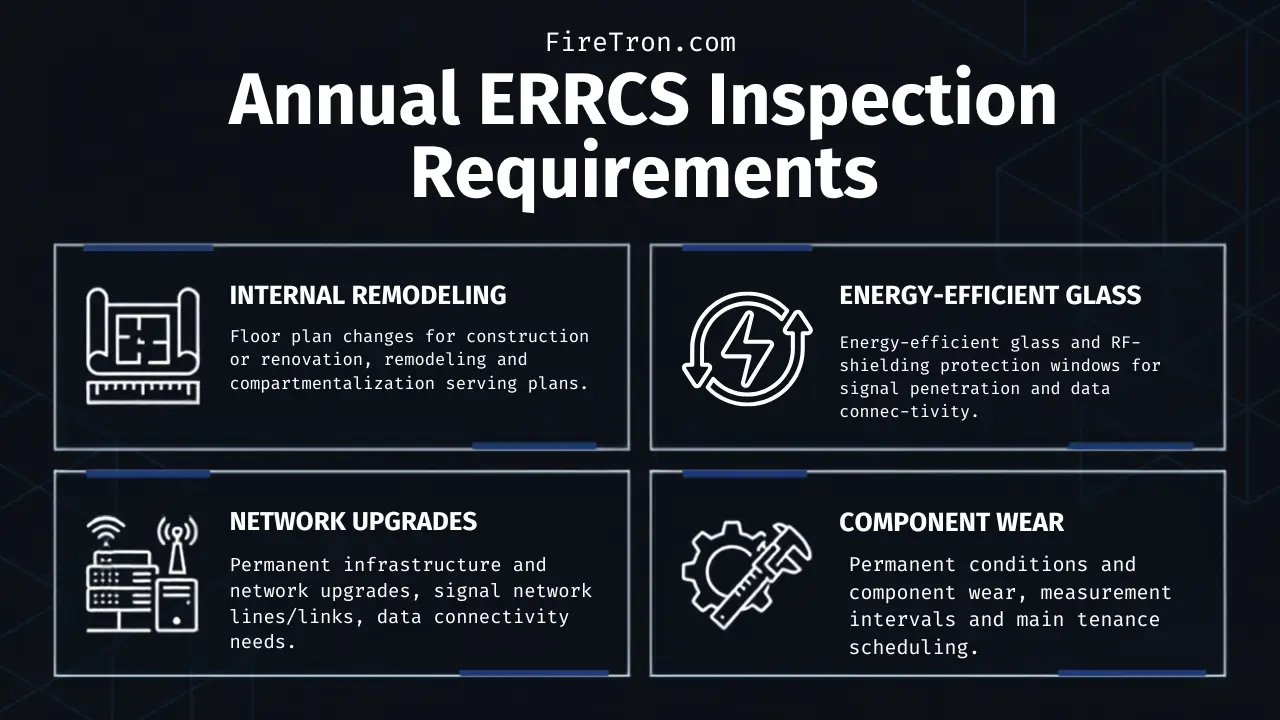 Compliance is not a one-time event achieved at building handover. An ERRCS inspection must be conducted annually to guarantee that the system remains operational over time. The internal radio frequency environment of a building is dynamic. Minor modifications can inadvertently degrade a system that passed inspection a year prior. Annual testing is mandatory because several everyday factors can disrupt coverage, including:
- Internal remodeling, such as adding drywall partitions or metal storage racks
- The installation of new energy-efficient window films or tinting
- Changes or upgrades to the external public safety radio tower networks managed by the city or county
- Natural component degradation, backup battery wear, or cable water damage
During the annual ERRCS testing requirements protocol, technicians re-verify the grid coverage, inspect the backup battery systems under load, and check the gain values of the bi-directional amplifiers. These measurements are cross-referenced with the original baseline documentation to detect any signs of component drift or system oscillation that could cause harmful interference to the city’s broader public safety network. Furthermore, many Texas jurisdictions require a comprehensive five-year recertification test, which involves an exhaustive evaluation of the entire system infrastructure to account for long-term wear and local code updates.
Partnering with FireTron for Certified Texas Compliance
Maintaining code compliance requires an experienced life safety partner who understands the distinct nuances of regional Texas code modifications. A system designed for a building in Houston may require entirely different frequency band submittals or enclosure ratings than one deployed in Dallas or Austin. Working with uncertified installers risks costly delays, failed inspections, and expensive post-construction retrofits.
From initial RF grid surveys to complex BDA system testing, system design, and mandatory annual certifications, our expert teams manage the complete compliance lifecycle. We ensure your facility meets all municipal fire codes, protects your property investment, and keeps local first responders safely connected when every second counts. Contact FireTron today to schedule your annual inspection or discuss the testing requirements for your next commercial project.
Did You Know? According to City of Santa Rosa Emergency Responder Radio Coverage Standard Public safety radio networks operate with lower signal density and fewer transmission sites than commercial cell networks, making inside-building coverage gaps common. Because building materials block these signals, modern fire codes require structures to pass radio testing to achieve 95% coverage on standard floors and 99% to 100% in critical operational areas before occupancy is granted.