When Does Your Building Need an Emergency Responder Radio Communication System?
During an emergency, seamless communication can mean the difference between life and death. First responders rely heavily on two-way radios to coordinate rescue efforts, manage tactical operations, and ensure public safety. However, modern building materials like low-E glass, reinforced concrete, and thick steel structures frequently degrade or entirely block these vital radio signals. When first responders step inside a facility and lose signal, operational safety is severely compromised. This is why local jurisdictions strictly enforce ERRCS testing requirements to verify that signal strength meets life-safety codes before a building can be occupied or renewed.
Understanding whether your facility mandates an emergency responder radio communication system requires a look at both model building codes and specific local ordinances. Navigating these requirements early prevents costly structural retrofits and ensures compliance with municipal authorities.
Understanding the Basics of an ERRCS System
An ERRCS system (also frequently referred to as an ERCES, or Emergency Radio Communication Enhancement System) acts as an in-building signal amplifier. It functions by capturing public safety radio signals from the nearest broadcast tower using an external donor antenna, passing those signals through a Bi-Directional Amplifier (BDA), and distributing them throughout the interior via a Distributed Antenna System (DAS).
The primary objective is to guarantee that the public safety radio coverage remains uninterrupted in critical areas like stairwells, basements, elevator shafts, and exit corridors. If a building fails to meet minimum signal strength benchmarks during initial construction or annual checks, the building owner must install an emergency radio communication system to bridge the coverage gap.
Code Triggers: When is an ERRCS Survey Mandated?
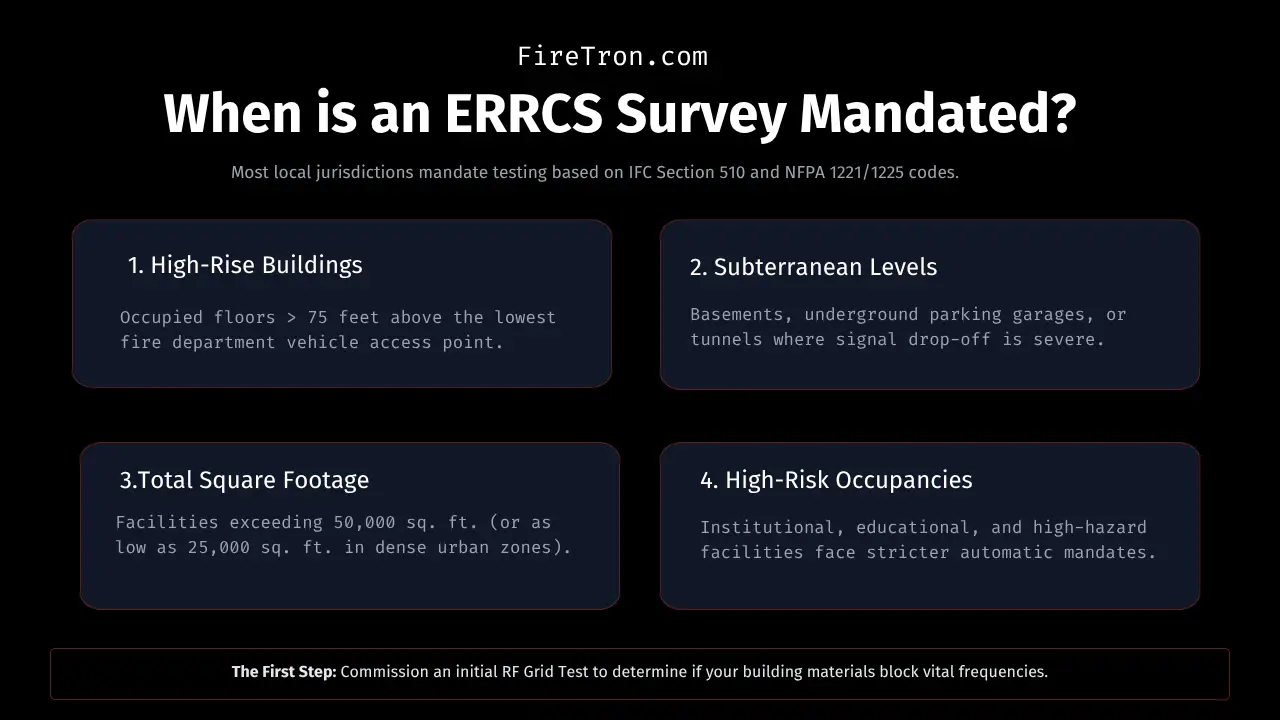
Most municipal mandates stem from two primary model codes: the International Fire Code (IFC) Section 510 and the National Fire Protection Association (NFPA) 1221 (or NFPA 1225 in newer editions). Local jurisdictions adopt and modify these codes to establish their specific building criteria.
Generally, an official ERRCS survey is triggered by the following property characteristics:
- High-Rise Buildings: Any building with an occupied floor located more than 75 feet above the lowest level of fire department vehicle access.
- Subterranean Levels: Structures featuring basements, underground parking garages, or tunnels where signal attenuation is naturally severe.
- Total Square Footage: Many jurisdictions automatically mandate testing for facilities exceeding 50,000 square feet, or sometimes as low as 25,000 square feet in dense urban zones.
- Specific Occupancy Classifications: Institutional, educational, and high-hazard occupancies often receive stricter scrutiny regardless of overall square footage.
The first step for any property owner or general contractor is to commission an initial RF grid test. This technical assessment determines if the existing structural materials already block vital frequencies, or if the building naturally allows sufficient signal penetration.
The Role of the Authority Having Jurisdiction in Radio Testing
Every municipality governs its public safety infrastructure uniquely. The local fire marshal or code official is known as the Authority Having Jurisdiction (AHJ). The AHJ establishes the precise frequencies utilized by local police, fire, and EMS, and defines the exact parameters for AHJ radio testing within their borders.
“The building owner shall be responsible for providing and maintaining the emergency responder radio coverage system in accordance with this section. The system shall be inspected and tested annually, or more frequently where required by the fire code official.”
— International Code Council (ICC), International Fire Code Section 510.6
Because the AHJ dictates the local testing criteria, compliance cannot be treated with a one-size-fits-all approach. For instance, some jurisdictions require 95% coverage across the entire building, while critical areas like fire pump rooms and internal staging areas must maintain 99% coverage. Engaging with certified professionals who understand local AHJ technical specifications avoids code violations and project delays.
Key ERRCS Testing Requirements and Compliance Cycles
Compliance is not a one-time event completed at building handover. Maintaining certification requires adherence to a strict schedule of testing, documentation, and preventative maintenance.
Initial Commissioning and Grid Testing
Before a new building receives its Certificate of Occupancy, it must undergo a rigorous 20-grid or 40-grid RF signal test. Technicians divide each floor into equal geometric zones and measure both uplink and downlink signal strength. If the results fall below the required thresholds, an enhancement system must be designed, permitted, and installed before occupancy is granted.
Annual ERRCS Inspection Mandates
Model fire codes mandate an annual ERRCS inspection to verify that the system continues to perform optimally. Over a year, internal building layouts might change, new tenant build-outs can add shielding walls, or nearby construction might block the line of sight to the donor tower. Annual testing verifies battery backup systems can sustain the amplifier for 12 to 24 hours during a power failure and checks that system gain levels remain perfectly balanced.
Five-Year Full System Re-Certification
Some jurisdictions impose an even deeper evaluation every five years. This comprehensive review includes testing active components, verifying coaxial cable integrity via line sweeps, and ensuring the antennas have not shifted due to weather or roof maintenance. Regular ERCES testing prevents system degradation and protects the building owner from liability.
Consequences of Neglecting BDA System Testing
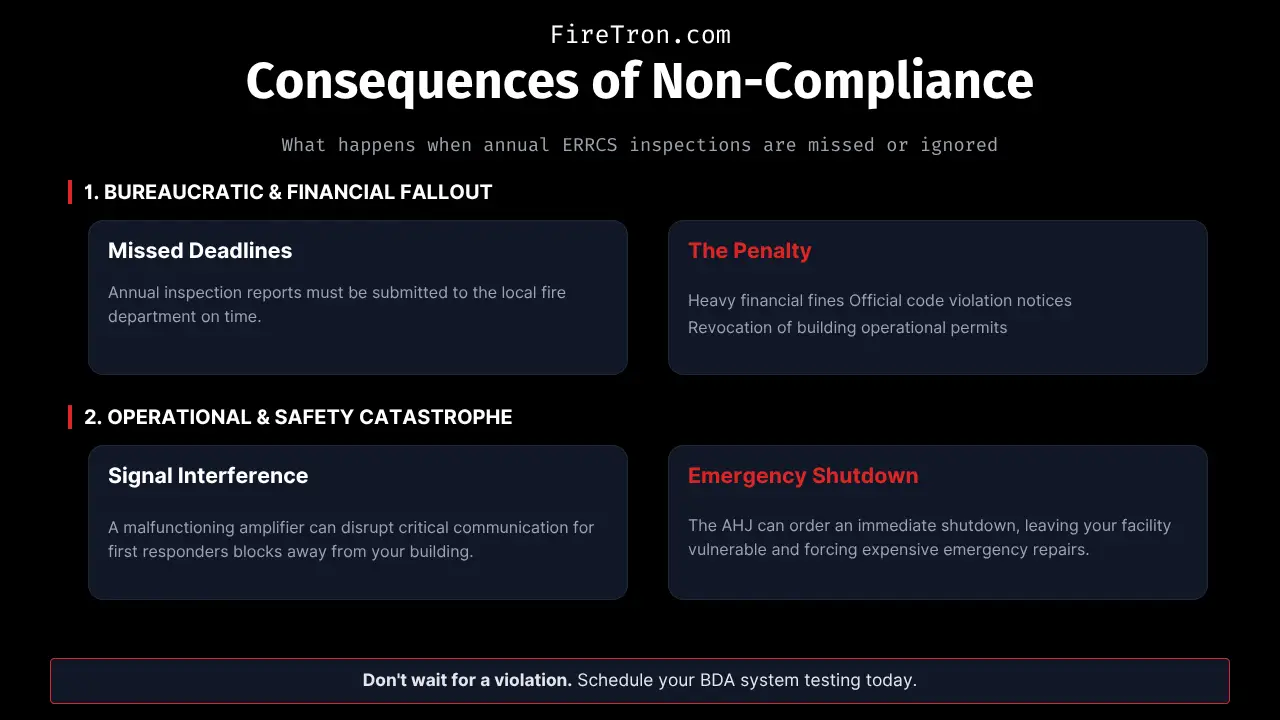
Failing to schedule regular BDA system testing carries severe operational and financial risks for commercial property owners. If an annual inspection report is not submitted to the local fire department on time, building owners face fines, code violation notices, or the potential revocation of their operational permits.
More importantly, an unmaintained or improperly configured system can introduce harmful interference into the public safety network. If a malfunctioning amplifier oscillates, it can disrupt communication for first responders blocks away from the building. In such scenarios, the AHJ has the authority to order an immediate shutdown of the system, leaving the facility vulnerable and non-compliant until emergency repairs are performed.
Securing Your Facility with Professional Testing Services
Navigating fire codes, RF frequencies, and municipal permits requires specialized technical expertise. Ensuring your facility complies with all local variations of ERRCS testing requirements protects your real estate investment and safeguards the emergency personnel who protect your tenants. Partnering with a certified life safety provider ensures your system remains fully operational, code-compliant, and ready for any emergency scenario. For expert guidance on layout surveys, initial engineering, or annual compliance checks, contact the experienced team at FireTron to keep your property safe and verified.
Critical Public Safety Fact: According to a comprehensive national assessment compiled by the Safer Buildings Coalition, approximately 60% of commercial buildings exhibit internal signal deficiencies that prevent reliable, life-saving two-way radio communications for emergency personnel without an active signal enhancement system installed.