Why Fire Inspection Tags and AHJ Notifications Matter for Code Compliance
For commercial building owners, managing safety infrastructure involves navigating a complex web of local, state, and national life safety regulations. While the physical hardware of your alarms and suppression equipment keeps the building safe, the documentation attached to that equipment keeps you legal. Two critical elements of this legal puzzle are physical markers and regulatory communications. Understanding how a fire inspection report and proper equipment tagging protect your commercial asset can prevent costly operational shutdowns.
In states like Texas, compliance is not passive. Local jurisdictions strictly enforce the National Fire Protection Association (NFPA) standards, meaning that oversight bodies track every deficiency and resolution. Property managers must realize that paperwork and communication with regulatory agencies are just as crucial as the physical functionality of their emergency assets.
The Hidden Importance of Fire System Inspection Tags on Safety Infrastructure

When a licensed technician completes an evaluation of your safety systems, the most visible indicator of that evaluation is a durable marker affixed directly to the equipment. A professional fire system inspection tags program serves as the first line of proof regarding property status. These physical indicators offer visiting code enforcement officers, insurance adjusters, and facility managers clear, immediate confirmation that your building meets regional safety expectations.
However, physical validation is only half of the requirement. The extensive evaluation data collected during the technician’s visit compiles into a formal fire protection inspection report. This detailed document lists every component examined, operational failures observed, and mandatory corrective actions. Maintaining these records is a foundational element of commercial asset management.
Meeting Strict Inspection Tag Requirements for Fire Suppression Systems
Regulatory frameworks dictate that life safety monitoring tools cannot simply be generic pieces of paper. Official oversight agencies lay out precise inspection tag requirements to prevent compliance gaps and maintain a traceable record of system servicing history. These physical markers must remain highly durable, legible, and firmly attached to control systems, risers, and primary panel boxes.
Decoding State Rules for Fire Sprinkler Inspection Tags
Water suppression equipment demands meticulous, systematic evaluation. Certified technicians use specialized fire sprinkler inspection tags to communicate whether a suppression line is active, partially compromised, or completely inoperable. In major business hubs governed by the Texas Department of Insurance (TDI) and the State Fire Marshal’s Office, a color system identifies equipment readiness:
- Green Tags: Signify that the entire apparatus passed its scheduled review and operates in compliance with zero outstanding faults.
- Yellow Tags: Point to a non-critical deficiency. The suppression system remains functional for emergencies, but components require servicing to meet full legal compliance.
- Red Tags: Alert property operators to a critical impairment. This status indicates the system is compromised, non-functional, or entirely broken, which demands immediate emergency service.
What Content Must Be Included for Valid Fire System Tagging?
To satisfy structural codes, the process of fire system tagging must display transparent accountability records. Valid tags must legally list the registration number of the safety enterprise, the license digits of the technician, the date of testing, and the precise category of review performed, such as an annual inspection or a deep five-year internal pipe investigation.
Deciphering a Fire Alarm Inspection Report and Suppression Findings
While physical tags deliver quick field updates on the mechanical floor, an official fire alarm inspection report acts as your legal protection during local code reviews and commercial insurance assessments. This comprehensive file logs the operational success of your control nodes, horns, strobes, pull stations, and backup batteries.
If an expert identifies any operational hazards, they document the severity within your master paperwork. Building managers generally receive a tight timeline to hire repair specialists and return the facility to proper operational status. According to safety standard clearinghouses, precise record keeping forms the backbone of commercial building preservation:
“Records of all system inspections, tests, and maintenance shall be maintained on the premises for a minimum of one year or as required by the authority having jurisdiction. These records provide a continuous history of the system’s performance and help demonstrate a commitment to building occupant safety.” — National Fire Protection Association (NFPA)
How AHJ Notification Impacts Your Property Operations
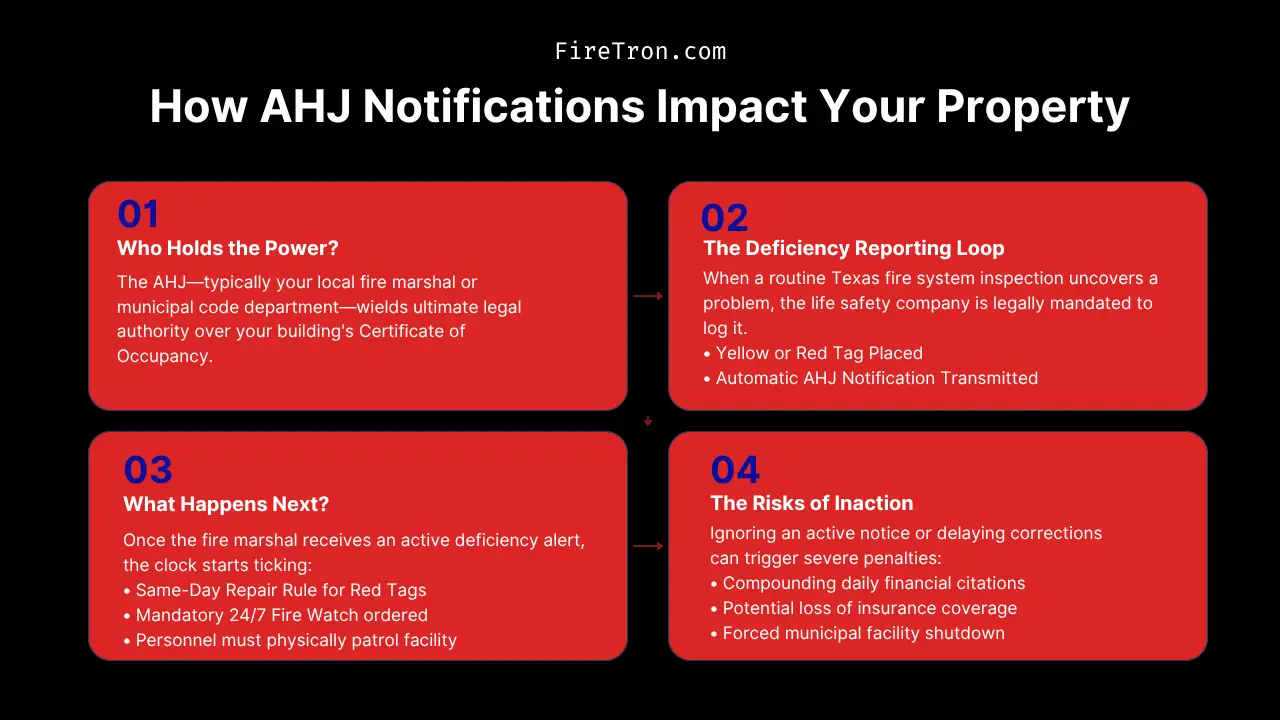
A frequently misunderstood variable in commercial property upkeep is the mandatory administrative feedback loop with code enforcement offices. The Authority Having Jurisdiction (AHJ), typically your community fire marshal or regional code department, wields full legal authority over your certificate of occupancy.
When a technician places a yellow or red marker on your equipment during a routine Texas fire system inspection, the fire safety enterprise is often legally bound to process an official AHJ notification. This digital or physical alert formally informs local fire marshals that a commercial asset under their supervision has an active deficiency or system impairment.
Property owners must act immediately once the AHJ is alerted. If a red tag issue cannot be repaired within the same business day, the local fire marshal may order a human fire watch, requiring dedicated personnel to walk the facility nonstop to look for hazards. Ignoring an active AHJ notice or delaying the required repairs can trigger severe code citations, compounding daily financial penalties, or a forced shutdown of your corporate facility.
Actionable Practices for Reliable Fire Inspection Compliance
Securing permanent fire inspection compliance calls for systematic operational tracking rather than scrambling right before an inspector arrives at your door. Property leaders can shield their assets by building a reliable tracking framework.
First, always hire a highly regarded, licensed life safety provider well-versed in local municipal amendments. Municipal laws often vary across city lines, so working with regional specialists guarantees that your documentation satisfies localized expectations.
Second, keep an organized repository of every historic fire inspection report generated for your facilities. Most regional codes demand that properties preserve these logs for several years. Having them quickly accessible saves immense time during unannounced municipal walkthroughs.
Finally, encourage facility teams to execute quick internal visual sweeps between your official inspection schedules. Ensure all panel boxes are unobstructed, pressure gauges show stable metrics, and that your tags remain clean and undamaged. Spotting a missing tag or a broken seal early lets you coordinate standard upkeep before code enforcement officers spot a violation.
Protecting a commercial development demands ongoing attention to your mechanical hardware and your regulatory paperwork. Building a partnership with a proven team like FireTron guarantees your building assets remain properly evaluated, accurately cataloged, and fully prepared to keep your business safe and compliant.