Fire Extinguisher Service Guide (2026)
Commercial Fire Protection | Compliance Guide | Published by FireTron Experts
Maintaining a safe and compliant commercial facility requires more than simply purchasing a fire extinguisher and hanging it on a wall. As building codes evolve and the 2026 updates to the National Fire Protection Association (NFPA) 10 standards take effect, facility managers must stay informed about proper fire extinguisher service, inspection, and maintenance protocols.
At FireTron, we understand that navigating fire safety compliance can be complex. Whether you manage a small retail space, a sprawling industrial warehouse, or a highly sensitive data center, having the right equipment in working order is your first line of defense against catastrophic loss. This comprehensive guide covers everything you need to know about commercial fire extinguisher service in 2026.
Differences Between Types of Fire Extinguishers
A common misconception in commercial fire protection is that all fire extinguishers are identical. In reality, using the wrong type of extinguisher on a fire can be ineffective or even highly dangerous. The primary differences between types of fire extinguishers lie in the extinguishing agent they contain and the class of fire they are engineered to suppress.
The NFPA classifies fires into five distinct categories based on the fuel source. Extinguishers are specifically formulated to combat one or more of these classes:
- Class A: Designed for ordinary combustibles like wood, paper, cloth, and plastics. These extinguishers typically use water, foam, or multi-purpose dry chemicals.
- Class B: Formulated for flammable liquids and gases such as gasoline, oil, paint, and propane. These units utilize dry chemicals, carbon dioxide (CO2), or clean agents to smother the fire and cut off oxygen.
- Class C: Rated for energized electrical equipment. The extinguishing agent must be electrically non-conductive. Once the equipment is de-energized, the fire transitions to a Class A or B hazard.
- Class D: Specialized for combustible metals like magnesium, titanium, and lithium. These require a unique dry powder agent that absorbs heat and forms a crust over the burning metal.
- Class K: Specifically engineered for commercial cooking media involving animal or vegetable fats and oils. These use a wet chemical agent that creates a soapy foam blanket to cool and suppress the fire.
Beyond the fire class, extinguishers differ in their mechanical operation. The most common commercial units are stored-pressure extinguishers, where the expellant gas and the firefighting agent are stored in the same chamber. Alternatively, cartridge-operated extinguishers store the expellant gas in a separate cartridge that is punctured prior to discharge. Understanding these differences is critical for proper selection and ongoing maintenance.
How Much Do Fire Extinguishers Cost to Install?
When budgeting for fire safety, the sticker price of the extinguisher itself is only a fraction of the total investment. The true cost to install fire extinguishers depends heavily on the mounting method, the type of facility, and local compliance requirements.
For a standard 5-pound or 10-pound ABC dry chemical extinguisher, the unit price typically ranges from $50 to $90. However, OSHA and NFPA 10 mandate specific installation parameters. Extinguishers must be readily accessible, conspicuously located, and mounted at precise heights. For units weighing under 40 pounds, the carrying handle can be no higher than 5 feet from the floor. The bottom of the extinguisher must also clear the floor by at least 4 inches.
Mounting Options and Associated Costs
The method of installation significantly impacts your final cost:
- Wall Brackets: This is the most cost-effective method. Basic heavy-duty metal brackets cost between $10 and $25. Professional installation labor typically adds $25 to $50 per unit. Total installed cost for a basic wall-mounted unit ranges from $85 to $165.
- Freestanding Floor Stands: Ideal for temporary setups, construction sites, or areas where wall mounting is impossible. Floor stands cost between $30 and $120 each. Because they require no drilling, the installation labor is virtually zero.
- Fire Extinguisher Cabinets: In high-traffic public areas, schools, hospitals, and retail centers, cabinets are often required to deter tampering and maintain aesthetic consistency. Surface-mounted cabinets cost between $80 and $200, while recessed cabinets range from $150 to $350. Professional installation for cabinets requires drilling into various wall materials and ensuring level mounting, which adds $75 to $250 in labor per unit. The total installed cost for a cabinet-housed extinguisher can range from $200 to $600+ per location.
Compliance Note: The Americans with Disabilities Act (ADA) requires that wall-mounted objects in corridors project no more than 4 inches into the path of travel. In narrow hallways, recessed cabinets or low-profile extinguishers are mandatory to avoid costly compliance violations.
Types of Fire Extinguishers and Which Environment They Are Required In
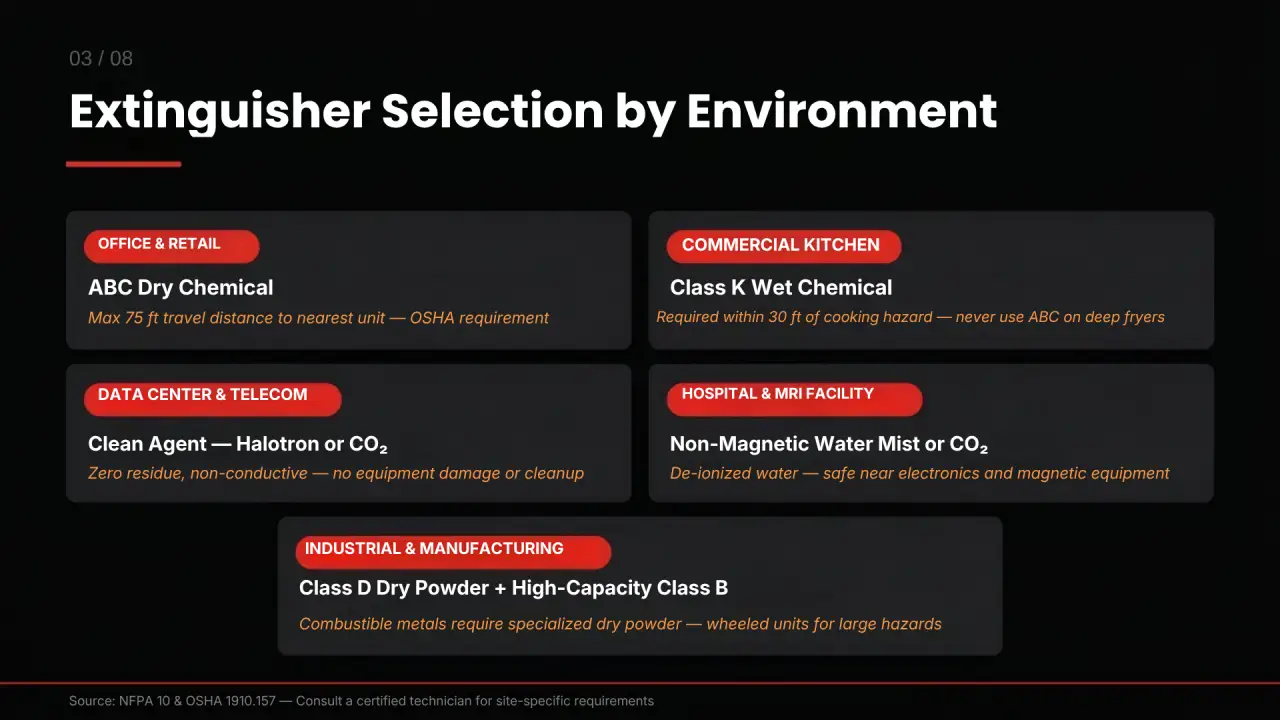
Proper hazard mapping is essential for commercial fire protection. Placing the correct type of extinguisher in the appropriate environment ensures rapid response and minimizes collateral damage to your property.
General Office and Retail Spaces
The standard ABC Dry Chemical Extinguisher is the workhorse of commercial fire safety. It is highly effective against ordinary combustibles, flammable liquids, and electrical fires. These units are required in general office areas, retail showrooms, hallways, and standard storage rooms. OSHA requires a maximum travel distance of 75 feet to reach a Class A rated extinguisher.
Commercial Kitchens and Restaurants
Any facility with commercial cooking equipment must have Class K Wet Chemical Extinguishers. These are required to be placed within 30 feet of the cooking hazard. The wet chemical agent reacts with hot grease to form a thick, soapy foam that prevents reignition. Standard ABC extinguishers should never be used on deep fryer fires, as the pressurized discharge can splash burning oil and spread the fire.
Data Centers, Server Rooms, and Telecommunications
In environments housing sensitive electronics, using a dry chemical extinguisher can cause more financial damage than the fire itself due to the corrosive residue left behind. These environments require Clean Agent Extinguishers (such as Halotron or FE-36) or Carbon Dioxide (CO2) Extinguishers. These agents are electrically non-conductive, leave zero residue, and require no cleanup. They are essential for server closets, robotics facilities, and control rooms.
Hospitals and MRI Facilities
Medical facilities present unique challenges, particularly in rooms containing Magnetic Resonance Imaging (MRI) machines. The powerful magnets can turn standard steel extinguishers into deadly projectiles. These environments require Non-Magnetic (MR Conditional) Water Mist Extinguishers or specialized non-magnetic CO2 units. Water mist extinguishers use de-ionized water that is safe around electricity and leaves no residue, making them perfect for clean rooms and healthcare settings.
Industrial and Manufacturing Facilities
Facilities that process or store combustible metals (like magnesium or aluminum shavings) must have Class D Dry Powder Extinguishers. Additionally, areas with high volumes of flammable liquids, such as chemical plants or fuel storage depots, require high-capacity Class B extinguishers or wheeled units to handle larger-scale hazards.
How Often Do Fire Extinguishers Need to Be Inspected?
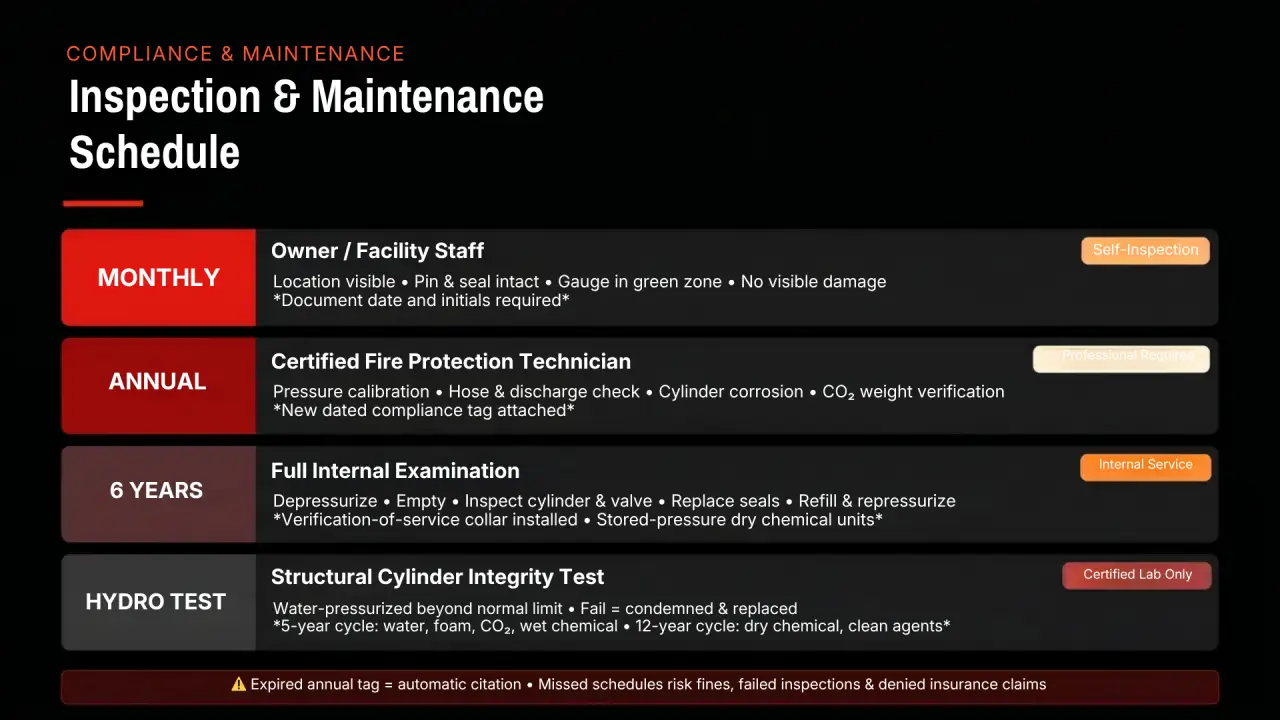
A fire extinguisher is only useful if it functions flawlessly during an emergency. To guarantee reliability, OSHA and NFPA 10 mandate a strict, multi-tiered inspection and maintenance schedule. Failing to adhere to these timelines can result in severe fines, failed fire marshal inspections, and denied insurance claims.
Monthly Visual Inspections
Every 30 days, a visual inspection must be performed. This is typically the responsibility of the building owner or designated facility staff. The monthly check ensures the extinguisher is in its designated location, is not blocked by obstructions, has an intact safety pin and tamper seal, shows no visible physical damage, and has a pressure gauge reading in the green (operable) zone. These inspections must be documented with the date and the inspector’s initials.
Annual Professional Maintenance
Once a year, a certified fire protection technician must perform a thorough maintenance inspection. This goes far beyond the monthly visual check. The technician will verify the pressure gauge calibration, inspect the hose and discharge mechanism, check for cylinder corrosion, and verify the weight of unpressurized units like CO2 extinguishers. Upon passing, the technician will attach a new, dated compliance tag. An expired annual tag is an automatic citation in almost every jurisdiction.
6-Year Internal Examination
For stored-pressure dry chemical extinguishers, a comprehensive internal examination is required every six years. The certified technician will completely depressurize and empty the unit, inspect the internal cylinder and valve components for pitting or corrosion, replace worn seals, and then refill and repressurize the extinguisher. A verification-of-service collar is installed around the neck of the cylinder to document this service.
Hydrostatic Testing (5-Year and 12-Year Cycles)
Hydrostatic testing verifies the structural integrity of the pressurized cylinder. The extinguisher is stripped down, filled with water, and pressurized beyond its normal operating limit to check for leaks or distortion. The frequency of this test depends entirely on the type of extinguisher:
- 5-Year Cycle: Required for water, water mist, AFFF foam, wet chemical (Class K), and Carbon Dioxide (CO2) extinguishers.
- 12-Year Cycle: Required for standard ABC and BC dry chemical extinguishers, as well as clean agent units like Halotron.
If a cylinder fails the hydrostatic test, it must be permanently condemned and replaced.
How Do You Recharge a Fire Extinguisher?
Recharging a fire extinguisher is the process of refilling it with the appropriate firefighting agent and restoring it to its proper operating pressure. This is not a do-it-yourself task. Attempting to recharge an extinguisher without proper certification, specialized equipment, and manufacturer service manuals is incredibly dangerous and violates fire codes.
An extinguisher must be recharged immediately after any use, even if only a tiny amount of agent was discharged. A broken tamper seal or a slight drop in pressure on the gauge also necessitates a professional recharge. Furthermore, recharging is a mandatory step during the 6-year internal examination and the hydrostatic testing processes.
The Professional Recharging Process
When you hire a certified fire protection company like FireTron to recharge your equipment, the technician follows a strict protocol:
- Depressurization and Emptying: The technician safely discharges any remaining pressure and removes the valve assembly. The remaining extinguishing agent is emptied and safely recovered.
- Internal and External Inspection: The empty cylinder is thoroughly cleaned and inspected for internal corrosion, thread damage, or structural weaknesses. The valve assembly, O-rings, and spring mechanisms are cleaned and evaluated.
- Component Replacement: The valve stem, O-rings, and any worn components are replaced to ensure a perfect seal.
- Refilling the Agent: Using a calibrated scale, the technician refills the cylinder with the exact weight and type of extinguishing agent specified by the manufacturer. Mixing different chemical agents can cause dangerous chemical reactions or render the unit useless.
- Repressurization: The extinguisher is pressurized with the appropriate expellant gas (typically medical-grade nitrogen) to the exact pressure level required.
- Leak Testing and Tagging: The fully assembled unit is tested for leaks, often using a water bath. Finally, a new tamper seal is installed, the safety pin is secured, and a new service tag is attached to document the recharge.
The cost to recharge a fire extinguisher varies by type. Standard ABC dry chemical units typically cost between $40 and $60 to recharge, while specialized clean agents or Class K wet chemicals can range from $100 to $300 due to the high cost of the chemical agents.
Other Fire Extinguisher Related Services
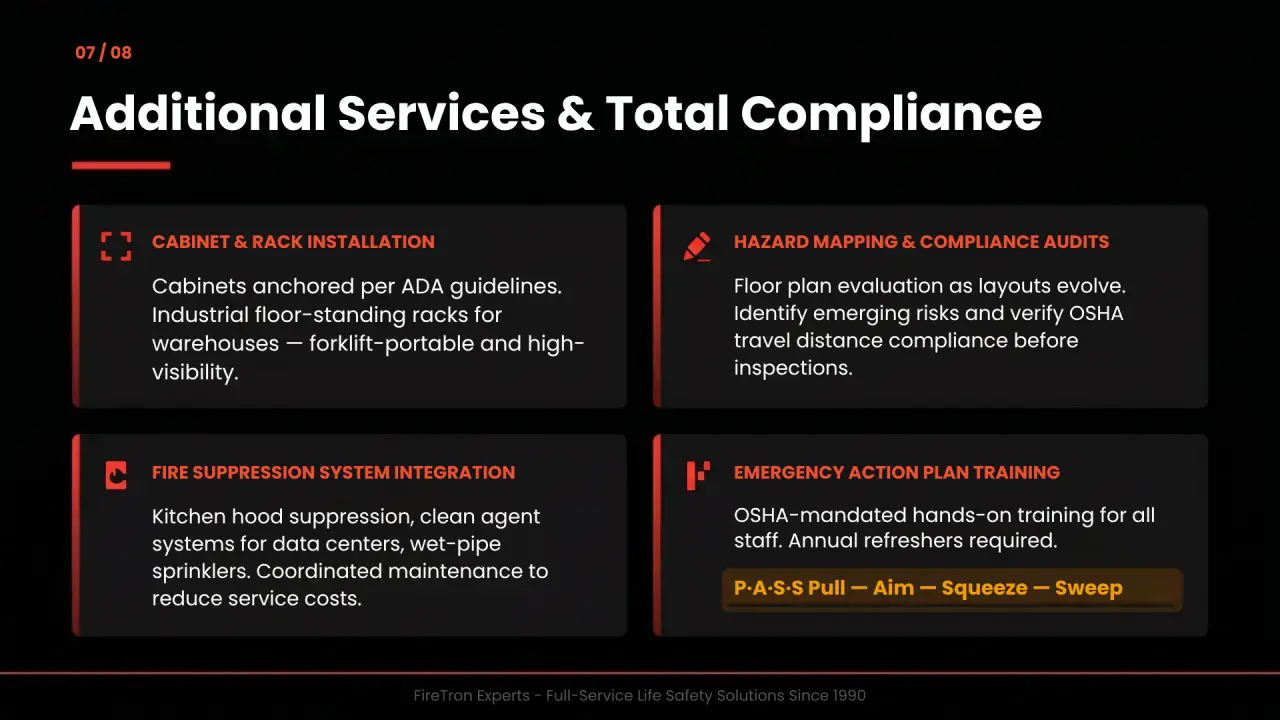
Comprehensive commercial fire protection extends well beyond portable fire extinguishers. To ensure total life safety and regulatory compliance, facility managers should partner with a full-service fire protection provider capable of handling all interconnected systems.
Fire Extinguisher Cabinet and Rack Installation
Proper storage is vital for accessibility and compliance. Professional installation services ensure that wall cabinets are securely anchored into drywall, masonry, or concrete, and that they meet all ADA protrusion guidelines. For large industrial spaces or warehouses, installing heavy-duty floor-standing racks provides high-density storage that is forklift-portable and highly visible.
Hazard Mapping and Compliance Audits
As businesses grow and floor plans change, fire risks evolve. Fire protection experts provide hazard mapping services to evaluate your current layout, identify new fire risks, and ensure that your extinguisher placement still meets OSHA travel distance requirements. This proactive approach prevents costly surprises during official fire marshal inspections.
Fire Suppression System Integration
Portable extinguishers are designed for incipient (early-stage) fires. They must work in tandem with automated systems. Related services include the inspection and maintenance of commercial kitchen hood suppression systems, clean agent systems for data centers, and traditional wet-pipe fire sprinkler systems. Coordinating the maintenance schedules of your portable extinguishers with your automated suppression systems streamlines facility management and reduces overall service costs.
Emergency Action Plan Training
OSHA requires that if employees are expected to use fire extinguishers, they must receive hands-on training upon initial assignment and annually thereafter. Professional fire protection companies offer live-fire or virtual reality training sessions to teach staff the P.A.S.S. method (Pull, Aim, Squeeze, Sweep) and educate them on when it is safe to fight a fire versus when to evacuate.
Protect Your Business with FireTron
Staying compliant with NFPA 10 and OSHA regulations is a continuous process. Whether you need an annual fire extinguisher inspection, a complex hydrostatic test, or a complete facility hazard assessment, the certified experts at FireTron are ready to assist. We provide transparent pricing, meticulous documentation, and the peace of mind that comes from knowing your property and personnel are fully protected.