Fire Alarm Monitoring Requirements for Commercial Buildings in Texas
For commercial facility managers, building owners, and property developers across Texas, protecting assets and ensuring human safety is a non-negotiable operational priority. Operating a commercial property involves navigating a complex web of national, state, and local safety standards. Among these critical safety protocols, understanding the legal and operational fire alarm monitoring requirements stands out as a vital component of a comprehensive risk management strategy.
In Texas, a fire alarm system does more than just sound an audible alert inside a building during an emergency. To satisfy local building codes, insurance mandates, and state regulations, these systems must remain actively linked to an approved central supervising station. This reliable 24/7 connection ensures that first responders are dispatched immediately when a fire or system fault occurs, safeguarding your business from catastrophic losses.
What Are the Core Fire Alarm Monitoring Requirements for Texas Businesses?
Commercial fire protection operates under a strict legal framework designed to minimize emergency response times. Under the Texas Insurance Code and local municipal ordinances, most commercial facilities are legally mandated to maintain dedicated 24/7 surveillance of their life safety infrastructure. This process relies on a licensed fire alarm monitoring company to oversee signals from the property and immediately notify local fire departments.
The primary standard governing these installations is NFPA 72 (National Fire Alarm and Signaling Code), alongside NFPA 101 (Life Safety Code) and NFPA 13 (Standard for the Installation of Sprinkler Systems). When these national benchmarks, along with the International Building Code (IBC) and International Fire Code (IFC), are adopted by Texas jurisdictions, they establish clear thresholds for when active transmission lines are mandatory. Generally, if a building has a fire alarm panel and/or fire sprinkler system, it will need to be monitored.
Active Signal Transmission and Code Compliance
Modern compliance dictates that your system must transmit distinct signal types to the central station. These include alarm signals (indicating an active fire event), supervisory signals (indicating an issue with a sub-system, such as a closed valve), and trouble signals (indicating a mechanical or electrical fault in the wiring or components). Relying on comprehensive fire alarm systems with reliable monitoring ensures that these distinct data packets reach dispatchers instantly, preventing false dispatches while maintaining constant system readiness.
How Local Jurisdictions Govern Fire Alarm Permits and Annual Renewal Processes
While the State Fire Marshal’s Office sets overarching regulatory guidelines across Texas, operational compliance is managed strictly at the municipal level. Commercial fire alarm systems generally must be permitted by the local jurisdiction having authority (AHJ). Navigating this administrative process and keeping the necessary legal permits active is the sole responsibility of the building owner or property manager.
Failing to secure or maintain these municipal system registrations can lead to severe local code penalties or an outright refusal by emergency dispatchers to respond to non-verified automated alarms.
Pre-Occupancy Rules for Net-New Facilities
Under current safety frameworks, all new commercial fire alarm installations are required to be monitored off-site by an approved supervising central station. Because active monitoring connection pathways must be completely verified before a commercial facility can open, these systems should be planned and integrated well in advance of building occupancy dates and final code inspections to avoid costly operational bottlenecks.
To evaluate compliant transmission paths including dedicated cellular and IP networks and secure custom system pricing, contact FireTron today for professional commercial fire protection monitoring options.
Securing and Renewing Your Annual Alarm Permit
Most Texas cities mandate that commercial properties obtain and maintain an active annual alarm permit. This registration must be renewed every twelve months, often requiring proof of recent system testing. For example, if you manage operations and utilize professional fire alarm monitoring in Houston TX, the City of Houston enforces strict permit registration protocols through its Administration and Regulatory Affairs department to reduce false alarms and keep building records accurate.
“False alarms stretch emergency response resources thin and delay reactions to real crises. Requiring annual permit registration and verification ensures that commercial systems are properly maintained by licensed professionals, keeping both occupants and first responders safer.”
Understanding Sprinkler Monitoring Requirements and Integrated Life Safety
A frequent point of confusion for facility managers is the intersection between water-based suppression systems and electronic notification networks. It is critical to recognize that automatic fire sprinklers do not operate in a vacuum. Under Texas building codes, the International Building Code (IBC), and the International Fire Code (IFC), there are rigid sprinkler monitoring requirements that mandate the integration of mechanical plumbing infrastructure directly into digital communication panels.
When a sprinkler head activates due to heat, water begins flowing through the overhead piping designed in accordance with NFPA 13 standards. A specialized waterflow switch detects this movement and triggers the fire alarm control panel. This transmission is not immediate; following both NFPA 13 and NFPA 72 protocols, the switch utilizes a preset mechanical delay that can take up to 90 seconds to verify sustained water flow. This built-in buffer is necessary to absorb temporary pressure fluctuations in municipal water mains and prevent disruptive false alarms.
If a commercial building does not have an active, certified connection to an off-site supervising station to track these signals once the 90-second verification window passes, emergency personnel will not be automatically summoned. This gap in communication risks massive structural and operational water damage before manual intervention can occur, directly violating the life safety standards outlined in NFPA 72.
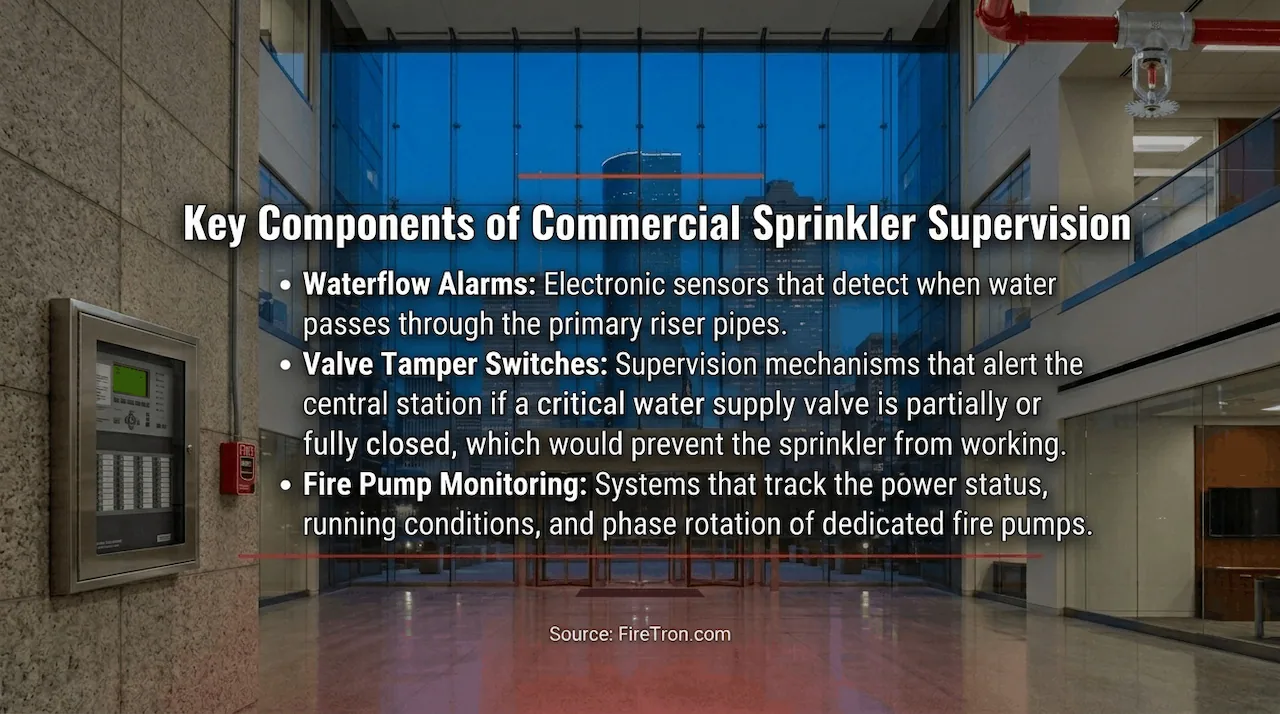
Key Components of Commercial Sprinkler Supervision
-
- Waterflow Alarms: Electronic sensors that detect when water passes through the primary riser pipes.
- Valve Tamper Switches: Supervision mechanisms that alert the central station if a critical water supply valve is partially or fully closed, which would prevent the sprinkler from working.
- Fire Pump Monitoring: Systems that track the power status, running conditions, and phase rotation of dedicated fire pumps
- Low/High Pressure: Monitors pressure levels within dry pipe, pre-action, or water supply systems. A low-pressure signal alerts management to potential leaks or compressor failures before a dry valve accidentally trips, while high pressure warns of over-pressurization that could damage system piping.
- Low/High Tank Level: Tracks the water volume inside dedicated fire protection storage tanks. Low-level alerts warn that the tank lacks the necessary water supply to meet hydraulic suppression demands during a fire, while high-level alerts signal float-valve failures or overfilling risks.
- Nitrogen System Malfunction: Supervises the operational health of specialized nitrogen generators used to prevent internal pipe corrosion. This signal flags issues like power loss, purity degradation, or continuous compressor runtime, indicating the system is no longer actively protected against pipe decay and requires maintenance.
Choosing a Licensed Fire Alarm Monitoring Company in Texas
Compliance is not just about having the right hardware installed; it is also about who is managing your signals behind the scenes. The state of Texas strictly regulates entities providing fire alarm monitoring services. Any vendor you select must hold an active license from the Texas Department of Insurance (TDI) State Fire Marshal’s Office.
Working with an uncertified provider can invalidate your commercial property insurance policies and result in code violations from the local Authority Having Jurisdiction (AHJ). A licensed partner ensures that your data lines utilize compliant transmission pathways, such as dual-path cellular communicators or IP-based networks, which have largely replaced traditional, legacy analog telephone lines.
The Benefits of Professional Fire Alarm System Monitoring
Enlisting a premium provider for your ongoing fire alarm system monitoring brings operational peace of mind that extends far beyond simple legal checkmarks. Continuous oversight means that minor system vulnerabilities, such as a dying backup battery or a dusty smoke detector causing a trouble signal, are addressed long before they escalate into costly system failures. Left unmanaged, these minor technical faults frequently trigger repetitive nuisance alarms that disrupt business operations and cause unnecessary occupant evacuations. This proactive approach keeps your property continuously protected and ready for annual municipal code inspections.
Ensuring Continuous Safety and Compliance Across Texas Regional Markets
Every commercial facility, whether it is a sprawling industrial warehouse, a multi-story medical center, or a local retail complex, demands a precise, compliant approach to life safety. Because local amendments can alter how national codes are enforced, partnering with an experienced, Texas-based protection specialist is the most reliable way to prevent compliance gaps, avoid costly operational fines, and protect human life.
Instead of managing complex scheduling and regulatory paperwork alone, smart facility operators rely on consistent verification models. We perform required and compliant system inspections at required intervals to ensure every component of your signaling network, suppression system, and notification panels works flawlessly together. For dependable protection, reliable technology, and comprehensive code adherence from a trusted partner, look to FireTron Inc.
Key Fire Safety Industry Statistic:
According to extensive safety data collected by the National Fire Protection Association, commercial properties utilizing integrated, professionally monitored fire systems experience significantly reduced property damage. In fact, structures equipped with functional automatic detection and localized notification systems cut the average civilian injury rate by more than 40% compared to buildings without active systems.
Learn more about national safety data directly from the NFPA Research and Data Analysis Division.