The Details of Installing a Commercial Fire Sprinkler System
A Comprehensive Guide for Business Owners, Property Managers & Facility Leaders Source & Industry Reference: FireTron.com
Why Every Commercial Building Needs a Professional Fire Sprinkler Installation
A code-compliant commercial fire sprinkler system is one of the most critical investments a business can make. Uncontrollable fires spread rapidly, and the presence of a properly installed fire sprinkler system can suppress or extinguish a fire before it becomes catastrophic, buying occupants the time they need to evacuate safely and keeping damage contained until first responders arrive.
According to the National Fire Protection Association (NFPA), sprinkler systems reduce the risk of dying in a fire by approximately 80% and cut commercial building fire damage by roughly 68%. These are not optional luxuries; for most commercial occupancies, fire sprinkler systems are legally required under the International Building Code (IBC) and NFPA 13.
Companies like FireTron, the largest individually owned life safety company in the state of Texas, specialize in the full lifecycle of commercial fire sprinkler systems: from initial consultation and custom system design, through installation and commissioning, to 24/7 monitoring and ongoing maintenance. Founded in 1990, FireTron brings over 35 years of proven reliability and partners with industry-leading manufacturers like Notifier by Honeywell, Silent Knight, Ansul, and Badger to deliver maximum performance and full code compliance.
This guide breaks down every step of the commercial fire sprinkler installation process, explains what business owners and property managers need to do to prepare, and covers the key differences between each type of commercial fire sprinkler system.
Types of Commercial Fire Sprinkler Systems
Before diving into the installation process, it is essential to understand the four primary types of commercial fire sprinkler systems. Each serves a different purpose, and the right choice depends on your building type, occupancy classification, environmental conditions, and the assets you need to protect.
1. Wet Pipe Sprinkler Systems
Wet pipe systems are the most common type of commercial fire sprinkler system. These systems keep water in the pipes at all times, allowing for immediate discharge the moment a sprinkler head is activated by heat. They are the most cost-effective and reliable option for standard commercial environments where temperatures remain above freezing.
Best suited for:
- Office buildings and corporate campuses
- Schools, universities, and educational institutions
- Retail stores and shopping centers
- Hotels, hospitals, and healthcare facilities
Cost range: Approximately $1.50–$4.00 per square foot for new construction; $5.00–$10.00+ per square foot for retrofit installation.
2. Dry Pipe Sprinkler Systems
Dry pipe systems fill the piping with pressurized air or nitrogen instead of water. Water is only released into the pipes after a sprinkler head activates and the air pressure drops, opening the dry pipe valve. This design prevents pipes from freezing in cold or unheated environments, though response time is slightly slower than wet pipe systems.
Best suited for:
- Unheated warehouses and cold storage facilities
- Parking garages and loading docks
- Outdoor canopies and covered structures
- Any space where pipes are at risk of freezing
Cost range: Higher upfront costs than wet pipe due to additional components (air compressors, dry pipe valves) and more complex installation. New construction typically runs $2.00–$5.00+ per square foot.
3. Pre-Action Sprinkler Systems
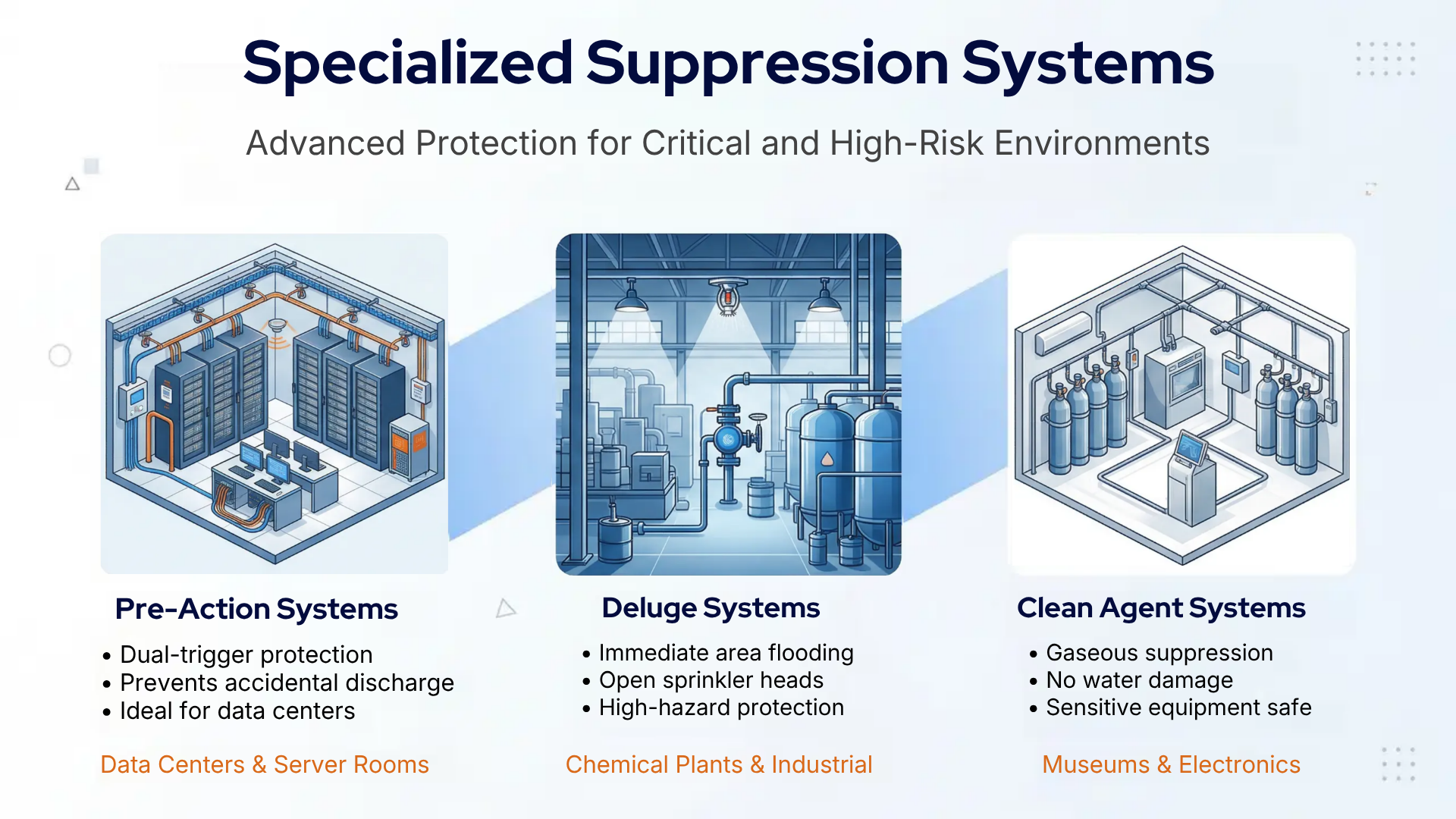
Pre-action systems are a hybrid approach that requires two independent triggers before water is released — typically a fire detection event (smoke or heat alarm) and the physical activation of a sprinkler head. This dual-action mechanism virtually eliminates the risk of accidental discharge, making pre-action systems the preferred choice for environments where water damage would be catastrophic.
Best suited for:
- Data centers and server rooms
- Museums, archives, and rare book libraries
- Telecommunications facilities
- Any environment with sensitive or irreplaceable equipment
Cost range: Among the more expensive sprinkler types due to the integrated detection system and specialized valves. Budget for the higher end of the $2.00–$8.00 per square foot range.
4. Deluge Sprinkler Systems
Deluge systems feature open sprinkler heads (no heat-sensitive element) and are designed to flood an entire protected area simultaneously when a connected detection system triggers the deluge valve. These are used exclusively in high-hazard environments where fires can escalate extremely quickly and require massive, immediate suppression.
Best suited for:
- Chemical plants and manufacturing facilities
- Paint booths and industrial spray operations
- Aircraft hangars and fuel storage areas
- Power generation and transformer rooms
Cost range: Highest installation cost of all sprinkler types due to large pipe sizes, high water demand, and specialized detection. These are typically for specialized, high-hazard industrial environments only.
5. Clean Agent Fire Suppression Systems (Specialty)
While not a traditional sprinkler system, clean agent systems (such as FM-200 and Novec 1230) are an important part of a comprehensive commercial fire protection strategy. These systems use gaseous agents instead of water, making them ideal for spaces where water would cause more damage than the fire itself. FireTron designs and installs clean agent suppression systems alongside traditional sprinkler systems to provide layered protection for commercial kitchens, data centers, and industrial process areas.
The Step-by-Step Commercial Fire Sprinkler Installation Process
A professional commercial fire sprinkler installation follows a structured, multi-phase process to ensure the system is perfectly matched to the building, fully code-compliant, and operational from day one. FireTron’s NICET-certified fire protection engineers and licensed technicians follow these steps on every project:
Step 1: Initial Consultation & Needs Assessment
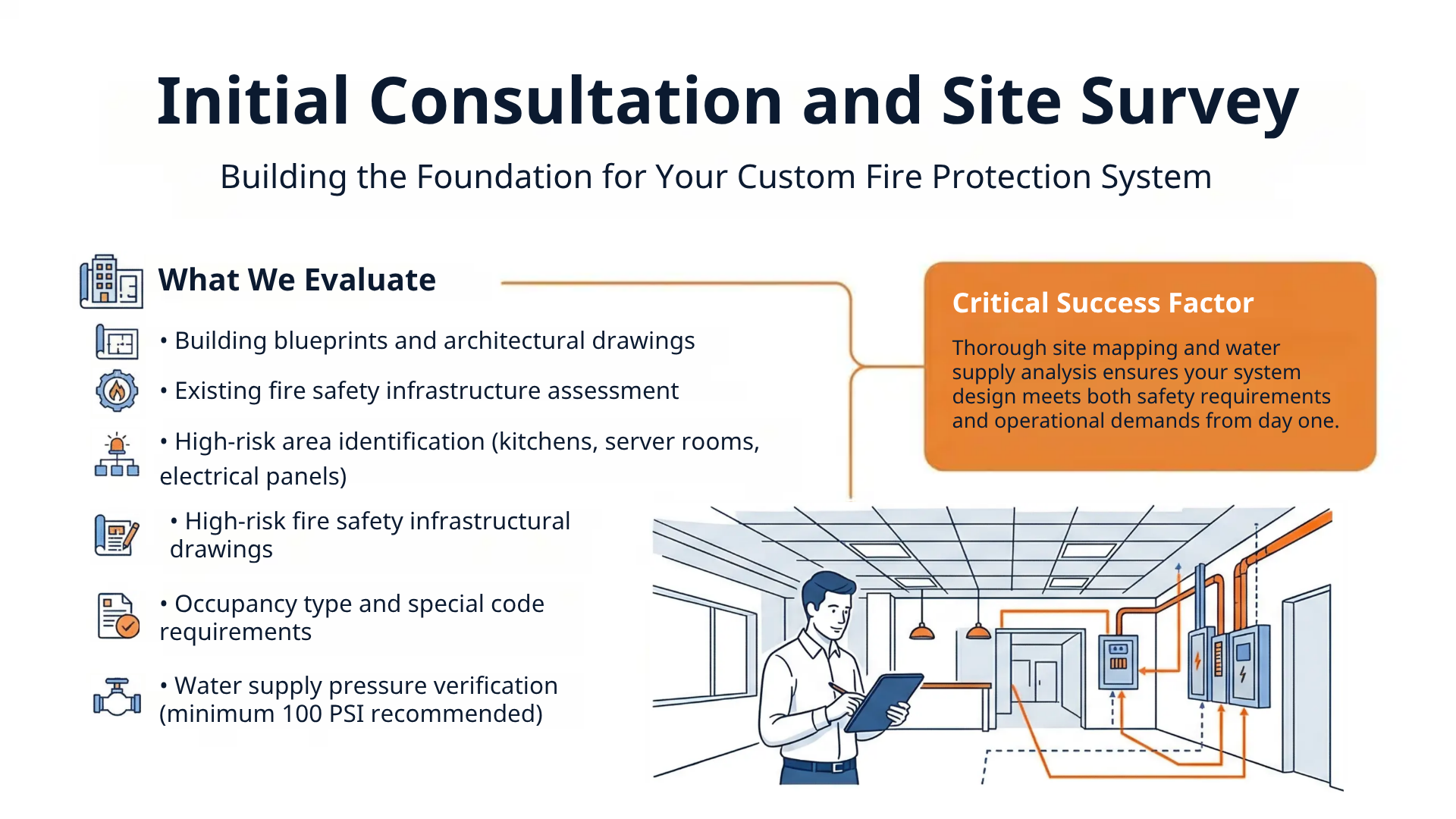 The process begins with a thorough consultation between the business owner (or property manager) and a fire protection engineering team. During this phase, the team evaluates the specific needs of the facility, including the type of occupancy, the nature of operations, the building’s construction materials, and any existing fire safety infrastructure already in place.
What businesses should prepare:
- Provide current building blueprints or architectural drawings
- Compile documentation of existing fire alarm and suppression systems
- Identify high-risk areas (kitchens, server rooms, chemical storage, electrical panels)
- Clarify budget expectations and project timelines
- Confirm occupancy type and any special code requirements from the local AHJ (Authority Having Jurisdiction)
Step 2: Site Survey & Kickoff
A licensed fire protection technician conducts an on-site survey of the building. This includes mapping the electrical layout, mechanical systems, water supply infrastructure, ceiling heights, and occupancy classification for every zone in the facility. The survey data forms the foundation for the custom system design.
What businesses should prepare:
- Ensure full access to all areas of the facility, including mechanical rooms, attics, crawl spaces, and utility closets
- Verify water supply pressure and capacity (100 PSI is the recommended minimum for most fire sprinkler installations)
- Provide access to electrical panels and confirm power availability for alarm and monitoring components
- Coordinate with building tenants or occupants to minimize disruption
Step 3: Custom System Design & Engineering
FireTron’s fire protection engineers create a fully customized system design based on the survey data and the specific requirements of the building. This includes detailed zone charts, device placement maps, riser diagrams, cable schedules, hydraulic calculations, and pipe routing plans. The design must comply with NFPA 13 (Standard for the Installation of Sprinkler Systems), the International Building Code (IBC), and all applicable local fire codes.
During this phase, the engineering team determines the appropriate system type (wet pipe, dry pipe, pre-action, or deluge) and selects the optimal sprinkler head type, spacing, and coverage pattern for each zone. The finalized design is submitted to the local Authority Having Jurisdiction (AHJ) for approval before installation begins.
What businesses should prepare:
- Review and approve the proposed system design with your internal stakeholders
- Coordinate with general contractors if the installation is part of a new construction or renovation project
- Confirm that the water supply meets the calculated demand for the designed system
- Obtain all necessary permits from the local AHJ before work begins
Step 4: Sprinkler System Installation
Licensed fire protection technicians carry out the physical installation of the piping network, sprinkler heads, control valves, alarm valves, fire department connections (FDC), and all associated components. Installation is typically scheduled during off-hours or phased strategically to avoid disrupting business operations and construction timelines.
Key installation activities include running piping from the water supply through the building (concealed in ceilings, walls, or exposed as required), installing sprinkler heads at calculated intervals for maximum coverage, connecting the system to alarm panels and monitoring infrastructure, and installing protective cages around sprinkler heads in low-clearance areas to prevent accidental activation.
What businesses should prepare:
Clear the installation zones of inventory, furniture, and obstructions to give the crew safe and efficient access. Coordinate with building management so that water shutoffs, ceiling tile removal, and noise-producing work are scheduled during low-traffic periods. Designate a single point of contact on-site who can make decisions and authorize work as needed.
Step 5: Testing & Commissioning
After physical installation is complete, the system undergoes rigorous testing and commissioning. Licensed technicians perform full-function testing of every component, including hydrostatic pressure tests to check for leaks, flow tests to verify water delivery to each sprinkler head, alarm verification to ensure all detection and notification devices are working, and AHJ walkthroughs where a local fire inspector reviews the installation for code compliance. Once testing is complete, the system receives UL certification and is officially cleared for operation.
What businesses should prepare:
Schedule the AHJ inspection and ensure all required documentation (permits, design drawings, test reports) is available for the inspector. Notify tenants and occupants that alarm testing will occur so they are not alarmed by audible notifications. Have your fire alarm monitoring provider on standby to coordinate the switchover to live monitoring.
Step 6: Turnover & Operator Training
The final step is the official system turnover to the building owner or property manager. FireTron provides detailed operation manuals, software automation setup for monitoring dashboards, and a real-time walkthrough with your team to ensure everyone understands how the system works, where the shut-off valves are located, and what to do in the event of an alarm or activation. Staff training is critical because even the best-designed system is only effective if the people in the building know how to respond properly.
What businesses should prepare:
Designate fire safety officers or building managers who will attend the training session. Develop an internal emergency action plan that incorporates the new sprinkler system. Establish a maintenance and inspection schedule in compliance with NFPA 25 (Standard for the Inspection, Testing, and Maintenance of Water-Based Fire Protection Systems).
How to Prepare Your Business for Each Type of Commercial Fire Sprinkler System
Different system types impose different preparation requirements. Here is a targeted preparation checklist for each:
Preparing for a Wet Pipe System
Confirm that all areas of the building maintain above-freezing temperatures year-round. Verify that your building’s water supply has adequate pressure and volume for the calculated hydraulic demand. Ensure ceiling access is available for pipe routing — coordinate with HVAC and electrical contractors if needed. Protect inventory and equipment directly below planned sprinkler head locations from potential water exposure during testing.
Preparing for a Dry Pipe System
Identify all unheated or freeze-prone zones in the building and clearly communicate these to your fire protection contractor. Ensure space is available for the dry pipe valve assembly and air compressor equipment, which require a heated, accessible mechanical room. Plan for slightly longer response times compared to wet pipe — discuss with your design engineer whether a quick-opening device (accelerator or exhauster) is needed. Budget for ongoing air compressor maintenance as part of your operational costs.
Preparing for a Pre-Action System
Catalog all sensitive assets (servers, archival materials, artwork, electronics) and map their exact locations within the facility. Ensure a compatible fire detection system (smoke detectors, heat detectors, or flame detectors) is installed or planned for the same zones. Coordinate with your IT department and facilities team to schedule installation around critical operations, as pre-action systems often protect mission-critical spaces. Budget for the more complex valve assemblies and integrated detection panels that pre-action systems require.
Preparing for a Deluge System
Conduct a thorough hazard assessment with your fire protection engineer to confirm that a deluge system is the appropriate solution for your risk level. Ensure the building’s water supply can handle the massive flow demand that deluge systems require (these systems discharge water from all heads simultaneously). Plan for significant water drainage infrastructure — deluge activations produce large volumes of water that must be managed. Implement robust waterproofing and drainage in the protected area to minimize secondary damage from a deluge event.
Why Texas Businesses Choose FireTron for Commercial Fire Sprinkler Installation
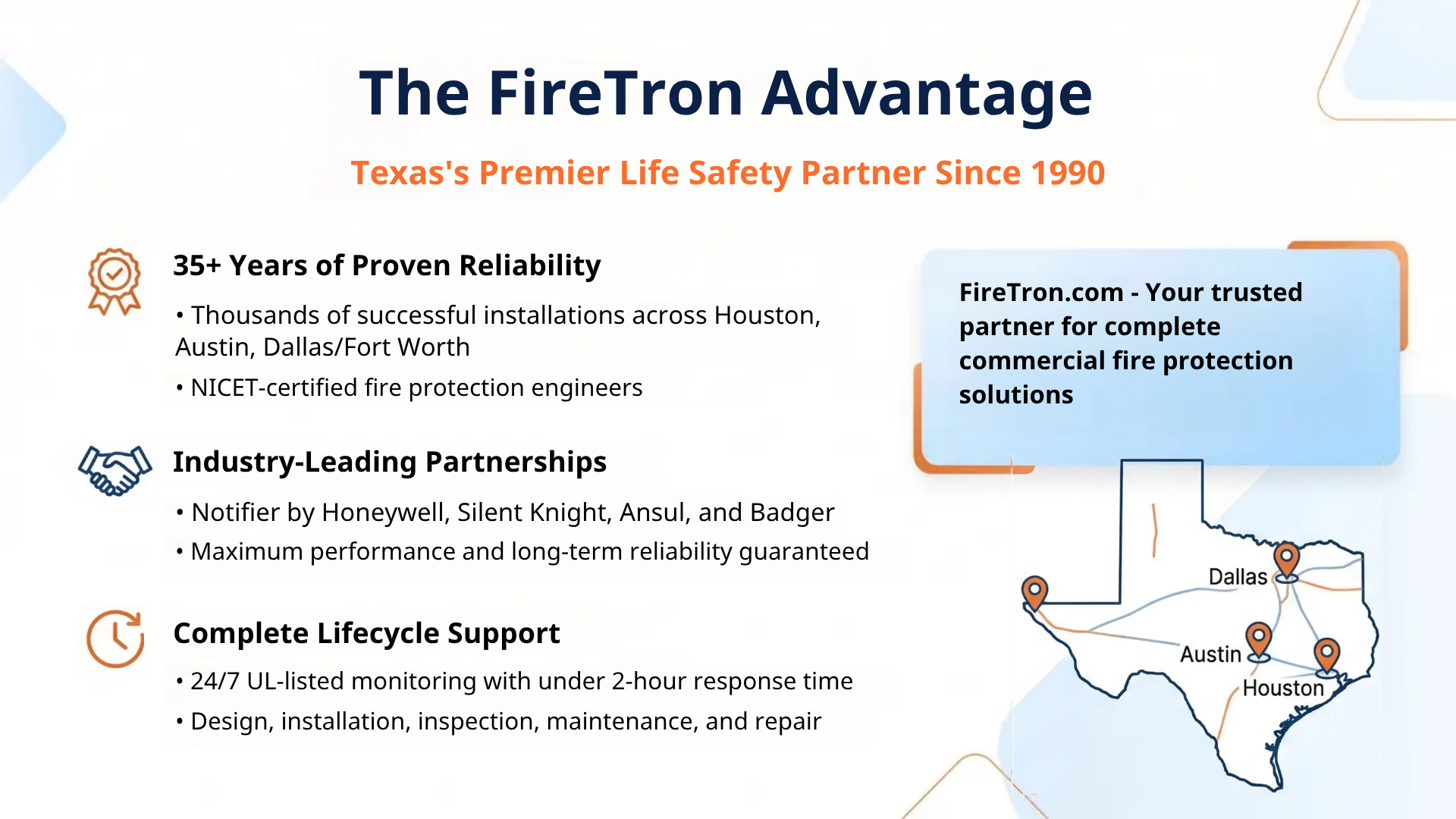 FireTron is not just a fire sprinkler installer; it is a full-service life safety company that has been protecting Texas businesses since 1990. Here is what sets FireTron apart:
35+ years of proven reliability with thousands of completed installations across Houston, Austin, Dallas/Fort Worth, College Station, and the Coastal Bend region. NICET-certified fire protection engineers ensure every system design meets or exceeds NFPA 13 and IBC requirements. Partnerships with industry-leading manufacturers including Notifier by Honeywell, Silent Knight, Ansul, and Badger guarantee that every component is built for maximum performance and long-term reliability. 24/7 monitoring through a UL-listed central station means your system is watched 365 days a year with an average emergency response time of under 2 hours. Full-service capabilities covering the complete lifecycle: design, installation, inspection, maintenance, repair, and monitoring all from a single trusted partner.
Whether you need to protect an office building, industrial site, commercial kitchen, school campus, healthcare facility, or data center, FireTron ensures you get the right fire sprinkler system for the job installed right, serviced proactively, and monitored around the clock.
Commercial Fire Sprinkler System Cost: What to Expect
The cost of installing a commercial fire sprinkler system varies widely based on system type, building size, installation complexity, and regional labor rates. In general, expect the following ranges:
New construction (wet pipe): $1.50–$4.00 per square foot
New construction (dry pipe / pre-action): $2.00–$5.00+ per square foot
Retrofit installation: $4.00–$10.00+ per square foot, depending on ceiling access, occupancy type, and system complexity
24/7 monitoring: $30–$100/month
Annual inspection & maintenance: $500–$1,500+, depending on system size and building complexity
Because no two commercial properties are exactly alike, FireTron provides tailored, accurate pricing quotes based on your building’s specific requirements. Contact FireTron today for a free consultation and custom estimate.
Protect Your Business Today
Installing a commercial fire sprinkler system is one of the most important steps any business can take to protect its people, property, and operations. From choosing the right system type to navigating the complexities of NFPA compliance, the process requires expert guidance every step of the way.
FireTron’s team of NICET-certified professionals is ready to consult with you, design a custom fire protection solution, and deliver a seamless installation backed by 24/7 monitoring and over three decades of experience. Whether you’re building from the ground up or upgrading an existing system, visit FireTron.com or call today to get started.